
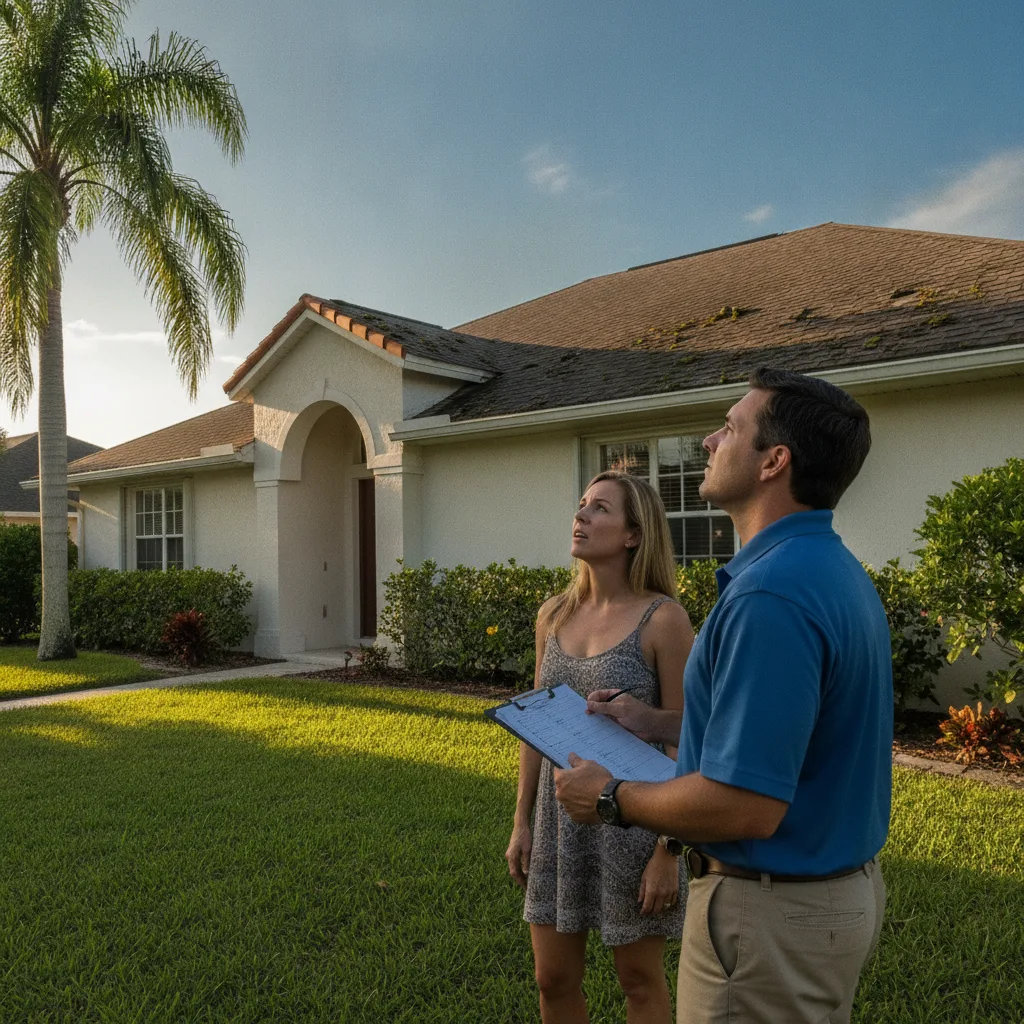
If you are buying, selling, or re-shopping insurance on a Florida home that is roughly 30 years old or older (many carriers now ask at 20, some at 15), your insurer will almost certainly require a 4-point inspection before they bind or renew the policy. The inspection covers four systems: roof, electrical, plumbing, and HVAC. And here is the number that matters: the roof is the most common reason Florida homes fail. A failed roof section does not just mean a repair bill. It can mean no coverage at all, a stalled closing, or a scramble to find a carrier that will take the risk at a much higher premium. The good news is that the roof section is also the most predictable part of the inspection, which means you can get ahead of it.
What the Inspector Actually Checks on Your Roof
A 4-point inspection is performed by a licensed home inspector or other qualified professional, and the roof section of the form asks a short list of pointed questions. How old is the roof covering, and what is it made of? What is its remaining useful life? Are there visible leaks, prior repairs, or active damage? Are there missing, cracked, or curled shingles, or cracked and slipped tiles? Is there evidence of water intrusion on the decking or ceilings? Most forms ask the inspector to estimate remaining life in years, and many carriers want to see at least 3 to 5 years remaining before they will bind coverage. An aging but functional roof can pass. A roof with visible deterioration, active leaks, or an expired service life usually cannot.
The Most Common Roof Findings That Fail a 4-Point
- Roof covering past its expected service life (the age math alone can fail it)
- Missing, cracked, or curled shingles, even in small areas
- Cracked, slipped, or displaced tiles that are visible from the ladder
- Ceiling stains or attic decking stains that show prior or active leaks
- Unsealed or deteriorated flashing at chimneys, valleys, and penetrations
- Visible sagging, soft decking, or structural deflection
- Patch-style prior repairs that were never brought up to code
Repair or Replace: What Actually Satisfies the Carrier
If the findings are localized, a documented repair by a licensed roofing contractor usually satisfies the carrier: the inspector re-checks, the form gets updated, and the policy binds. If the roof covering itself is at or past its expected service life, most carriers will not accept spot repairs, because the age math still fails. At that point a full replacement is the fix, and it changes more than the pass mark. A new roof to current Florida Building Code resets the age clock for the 4-point, typically improves your wind mitigation report at the same time, and takes the non-renewal target off your back for years. On an older Florida home, the roof is not just one quarter of the 4-point. It is usually the whole ballgame.
4-Point Inspection Roof Questions
- Do you perform 4-point inspections?
- No. A 4-point inspection covers four home systems and is performed by a licensed home inspector or other professional qualified across all four. What we do is the roofing side: a free roof inspection that tells you whether your roof would pass, the repairs that fix what an inspector would flag, and full replacement when the roof is past its serviceable life.
- How old can a roof be and still pass a 4-point inspection in Florida?
- There is no single statewide cutoff. Carriers generally want to see remaining useful life, commonly 3 to 5 years, and many get uncomfortable with asphalt shingle roofs past 15 to 20 years and tile systems where the underlayment is past its life even if the tile looks fine. Condition matters as much as age: a well-maintained 18-year-old roof can pass while a neglected 12-year-old roof fails.
- My 4-point flagged the roof. How fast can it be fixed?
- Localized findings like cracked tiles, missing shingles, or flashing details are often repaired within the same week, and we provide the documentation your inspector or carrier needs to update the form. Full replacements depend on permit timing through your municipality, typically 1 to 3 weeks before install, with the install itself usually 2 to 4 days. If a closing date is driving the timeline, tell us on the first call and we will schedule around it. Call (561) 917-5288.
- Is a 4-point inspection the same as a wind mitigation inspection?
- No, and they are usually done together. The 4-point tells the carrier whether your home's four major systems are insurable. The wind mitigation inspection documents the wind-resistance features that earn premium discounts. The 4-point protects your coverage. The wind mit lowers its cost. Both lean heavily on the roof.
Storm hit your home? We'll document it.