
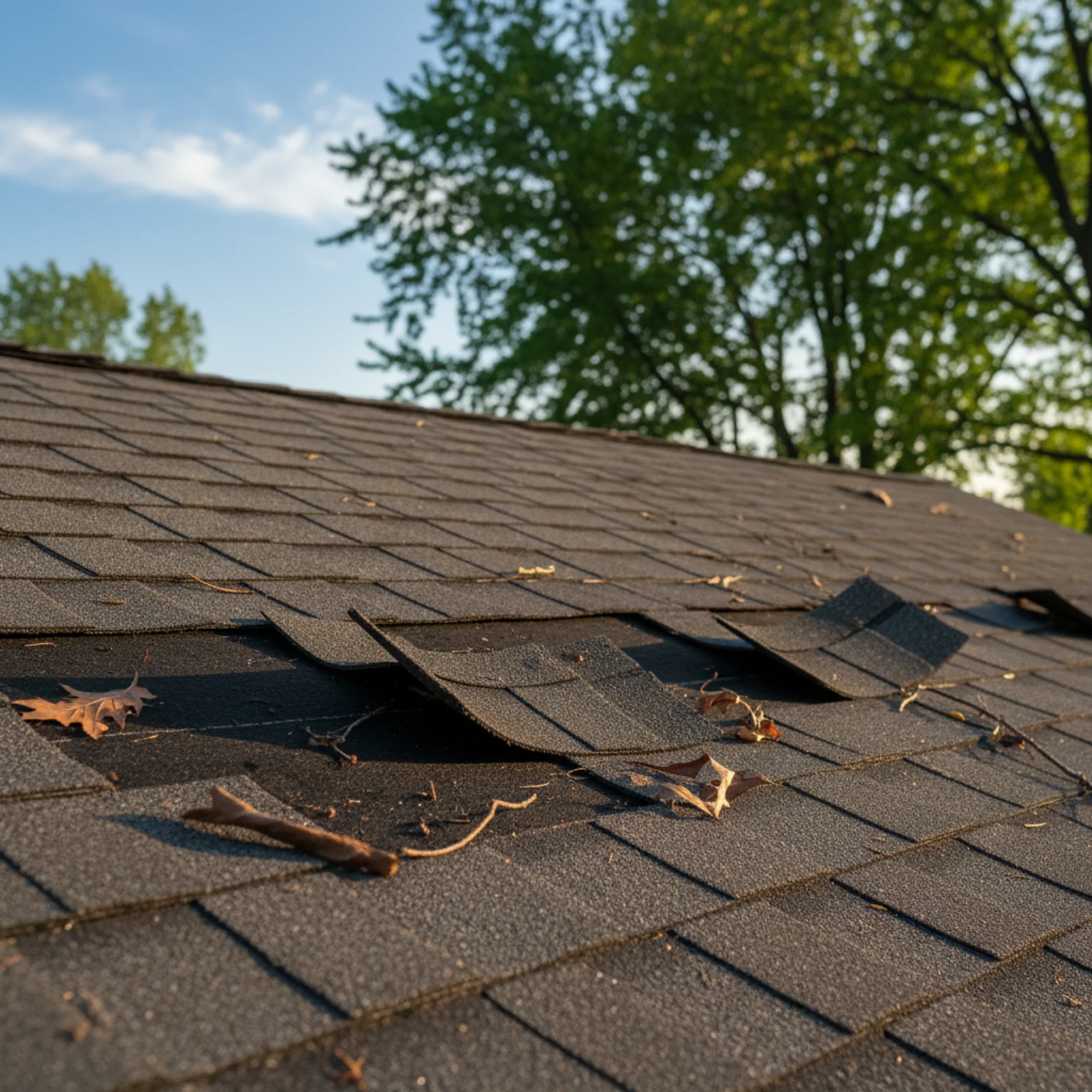
Most thunderstorms that drop hail also produce wind. Most named storms that produce wind also drop debris. So when an adjuster shows up at a Maryland or Florida home after a storm, the first thing the inspection determines is which damage came from which mechanism, because they are filed, photographed, and quoted differently. A roof can absolutely have both. Knowing how to read each pattern saves you a return inspection and keeps the claim file from getting kicked back as 'maintenance' instead of 'covered loss.'
Hail Damage: The Round-Bruise Signature
Hail damage on an asphalt shingle is a circular impact bruise. The granules are dislodged in a round pattern (the size of the stone), and the asphalt mat underneath is fractured. From a distance the bruise looks like a dark spot. Up close, you can see the loss of the protective granule layer and a soft, slightly compressed feel when you press on it. Hail damage is random because it lands wherever the stone fell, so it appears across the slope in a scatter pattern, with heavier concentration on slopes facing the storm direction. It almost never falls in straight lines.
Wind Damage: The Lift-and-Crease Signature
Wind damage on an asphalt shingle is the shingle being lifted off its sealant strip and either folded back, creased, or torn loose entirely. The pattern is directional: shingles lift in the direction the wind blew, so a south-facing slope from a north-blowing storm shows lifted tabs at the south edge of the slope. Look for visible creases that run parallel to the bottom edge of the shingle. Those are stress fractures from the shingle bending in the gust. Once a shingle is creased, even if it has settled back down, the seal is broken. The next strong wind takes it off entirely.
Quick Visual Cheat Sheet
If you can identify these patterns from the ground, you can call the right kind of inspection before the adjuster shows up.
| Hail damage | Wind damage |
|---|---|
| Round, circular impact bruises | Lifted, creased, or missing tabs |
| Granule loss in scattered dots | Granule loss along the leading edge of a tab |
| Random across the slope | Directional, heavier on the windward edge |
| Soft to the touch where impacted | Visible folded or torn shingles |
| Soft metal also dented (AC, gutters, mailbox) | Tree limbs down, fence sections leaning |
| NOAA hail report confirms stone size | NOAA storm report confirms gust speeds |
The Slopes That Take Damage First
Hail and wind both have a directional bias. In Maryland thunderstorms, the prevailing storm motion is west-to-east or southwest-to-northeast, so south and west slopes typically take the heaviest hail concentration, and west-facing roof edges show the most wind uplift. In Florida named storms, the wind direction shifts as the storm passes, so a single roof can show wind damage on opposite slopes from the same event. This is why our written damage report includes a slope-by-slope diagram with a north arrow. The adjuster needs to confirm that the directional pattern matches the storm track on file with NOAA. If the damage pattern doesn't match the storm direction, the carrier will question the claim.
When You Have Both
Most strong storms produce both mechanisms, and most MD claims our documentation supports include both line items. Carriers are fine with that. What they don't accept is mixing the two. A creased shingle gets the wind line item; a granule-loss bruise gets the hail line item. Mislabeling one as the other is a common reason for claim adjustments. The repair scope often ends up the same (replace the affected slopes) but the documentation must keep them separate. Our written damage report itemizes each impact and each lifted tab on a per-slope tally so the adjuster can match each line to the photo evidence.
Why Aged Roofs Get Harder to Claim
On a roof more than 15 years old, both hail and wind damage are harder to document because pre-existing wear (granule loss from sun exposure, aged sealant strips that fail in moderate wind) competes with storm damage on the photo evidence. Adjusters routinely deny aged-roof claims as 'wear and tear' rather than 'covered loss.' This is one of several reasons documentation matters more on older roofs, not less. The chalk test (see our hail documentation guide), tight time-stamped photos, and a NOAA storm report that matches the date are what separate a covered claim from a denied one. If you have an older roof and a recent storm event, schedule the free inspection inside the carrier's notice window, not three months later.
What Our Inspection Adds
When we do a free roof inspection after a storm in Baltimore County, Anne Arundel County, or Palm Beach County, we produce a damage report with: chalk-circled impacts on each affected slope, lifted-tab counts with photos and the slope's compass direction, granule wash measurements at each downspout, soft-metal damage on adjacent property (AC condenser, gutter aprons, downspouts), and a written repair scope priced to the latest Xactimate database. We give you the report. You file the claim or hand the report to your independent agent or public adjuster. We can attend the adjuster's site inspection as the contractor of record so technical questions about the roof itself get answered on site, but the claim is yours to file, in your name.
Hail vs Wind: Common Questions
- Can a roof have hail damage I can't see from the ground?
- Yes. A 1-inch hailstone will not always crack a shingle from below; sometimes the granule loss is the only visible mark. From the ground, granule loss looks like darker spots scattered across the slope. The chalk test (rub chalk on a 4-foot square; impacts show as dark dots) is the homeowner-friendly way to confirm before climbing.
- What wind speed actually damages an asphalt shingle?
- Most modern architectural shingles are warranted to withstand 110 to 130 mph sustained gusts. Damage typically begins around 50 to 60 mph for older shingles with degraded sealant. Florida code requires higher wind ratings (HVHZ rated, up to 170 mph in Miami-Dade and Broward) than Maryland, so a 'wind-damaged' shingle in MD might be a code-compliant shingle that simply aged out of seal.
- Will my carrier replace the entire roof or just affected slopes?
- Depends on the policy form, the carrier's matching guidelines, and state law. Some states and policies require matching of adjacent slopes if the existing shingle is no longer manufactured (so the patched slope wouldn't visually match). Maryland and Florida both have insurance bulletins on this. Your independent agent or public adjuster is the right source for your specific policy's matching language.
- Do I need to file separate claims for hail and wind?
- No. A single claim can cover both perils as long as they came from the same storm event. The line items inside the claim get itemized separately, but it's one claim, one deductible, one inspection.
Storm hit your home? We'll document it.